

14 Jul Hot Take: Your Traffic is Lying to You, and Your Board Already Knows it
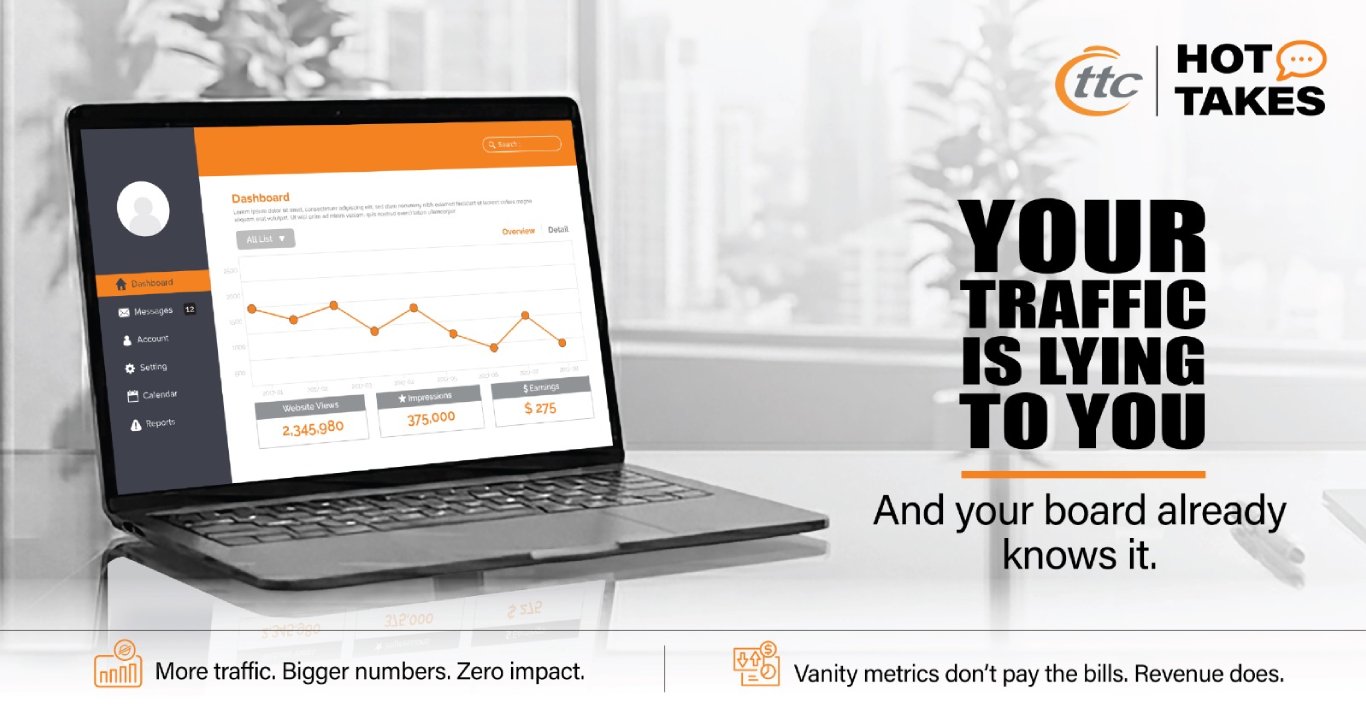
Traffic is the most over-celebrated vanity metric in marketing.
It looks great on dashboards. It keeps teams busy. It gives the comforting illusion of momentum. But the moment the board asks about revenue, traffic goes suspiciously quiet.
That’s because traffic was never the goal. It was just the easiest thing to measure.
Here’s the uncomfortable truth: visibility has decoupled from intent. Today’s buyer doesn’t arrive the way your funnel assumes. They skim, compare, validate and often decide before your analytics even registers a session. Between AI-generated summaries, zero-click searches, peer conversations, and dark social, 60% of decision-making now happens somewhere your Google Analytics will never see.
When traffic goes up and revenue doesn’t, that’s not a performance issue. That’s a relevance issue.
Most teams are still playing the old game: optimize for reach, assume intent will follow. It rarely does. High traffic with low conversion usually means one thing: you’re attracting attention, not conviction. And conviction is the only thing that actually drives the pipeline.
This is the quiet failure mode of most growth strategies. Budgets pour into acquisition. Campaigns push for scale. Reports celebrate session counts. But nobody asks the harder question: are those sessions from actual buyers, or just people passing through?
More traffic doesn’t fix weak positioning. It amplifies it and lets everyone see the cracks.
(LinkedIn’s 2025 B2B Marketing Benchmark found 93.7% of marketers agreed trust is the most important factor for B2B brand success, 62.3% valued peer recommendation over high awareness, and 58.1% valued customer endorsement over analyst endorsement.)
More traffic doesn’t solve poor messaging. It exposes it to the exact people you were trying to impress.
(LinkedIn’s benchmark also shows that customer recommendations and peer recommendations were more influential than price, fame, or features in building trust.)
More traffic doesn’t create demand. It tests whether demand exists in the first place.
The brands actually growing right now aren’t chasing volume. They’re engineering intent. They know exactly who they want, what they stand for, and why it matters to that specific person.
Their content doesn’t just attract; it qualifies.
Their messaging doesn’t just inform; it sharpens the decision.
The real question isn’t “How do we get more traffic?” It’s “Why isn’t the traffic we have converting?” If your growth plan is just “more”, you’re solving the wrong problem entirely.
TTC POV:
Traffic is a signal. Not a destination.
At TTC, we don’t pop champagne over pageviews. We treat traffic as one data point in a much bigger question: Is the right intent reaching the right offer through the right path?
The real work is tightening your ICP, aligning content to genuine buying signals, and building conversion paths that turn attention into action, not just sessions into bounce rates.
In a zero-click, AI-shaped discovery world, visibility without relevance isn’t just inefficient. It’s invisible. If your numbers look strong but your pipeline doesn’t, the problem isn’t volume. It’s direction. We’re ready to provide you with direction; just reach out to us.