

05 Sep Why Event Content Needs a Funnel, Not Just a Theme
Let’s be honest—most B2B events look great on paper. There’s a catchy theme, an impressive panel, and even a creative title that makes people click “Register.” But ask the sales team a month later: “How many deals did this event actually influence?” and you’re likely to get an awkward silence.
That’s the trap CMOs keep falling into—the “nice event, no leads” problem.
According to the Content Marketing Institute, 68% of B2B events fail to create actionable follow-ups. Which means that nearly 7 out of 10 times, all that money and effort only created a one-day show, not a lasting business impact.
And the truth is, the problem isn’t with events. It’s with event content.
Why Themes Aren’t Enough
Themes are great for marketing flair, but they don’t drive buyer journeys. A theme gives your event a vibe, but a funnel gives it purpose.
As one Gartner analyst put it bluntly:
“If your event content doesn’t guide the buyer, it’s just entertainment.”
Think about it. If your event agenda is packed with high-level keynotes that inspire, but doesn’t move attendees toward actual solutions, you’ve essentially built a TED Talk series — not a demand-generation engine.
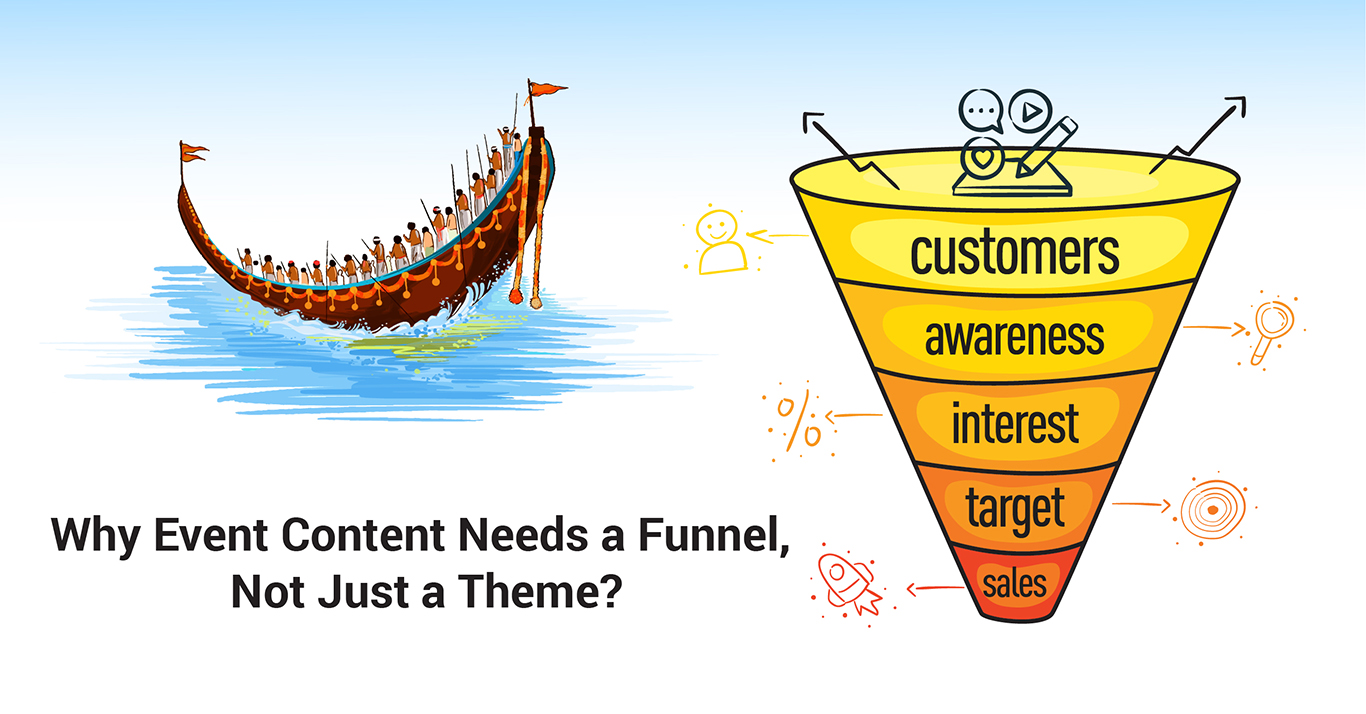
And here’s where today’s celebration of Onam gives us a timely lesson. Onam isn’t just about the colours of the pookalam, the joy of Onam Sadhya (the grand feast), or the excitement of cultural processions. Those are the themes — the things you see and experience on the surface. What makes Onam truly meaningful is the underlying purpose: honouring King Mahabali, celebrating prosperity, and bringing communities together in unity.
In the same way, your event can’t just look good on the outside. A strong theme may attract attendees, but without a funnel — without that deeper purpose and structure — it won’t create lasting impact. Just like Onam’s rituals guide the celebration to meaning, your event content must guide buyers along a journey: from awareness, to consideration, to decision.
Funnel-First Event Content
Here’s what funnel-first content design looks like in action:
- Awareness Sessions (TOFU)
These spark curiosity. They frame the “why now?” moment. For example: “AI is rewriting cybersecurity — here’s what that means for your enterprise.”- Goal: Grab attention, position urgency.
- Formats: Keynotes, fireside chats, visionary talks.
- Consideration Sessions (MOFU)
These shift the conversation from “why” to “how.” They showcase frameworks, comparisons, and best practices.- Goal: Help prospects see solutions in context.
- Formats: Panel discussions, expert roundtables, analyst presentations.
- Decision Sessions (BOFU)
This is where the rubber meets the road. Demos, case studies, and customer success stories take center stage.- Goal: Show tangible proof and make the next step obvious.
- Formats: Live demos, customer panels, breakout workshops.
Just like the layered traditions of Onam — from pookalam designs to the grand Onasadya feast — every piece of event content should build on the previous one, guiding attendees from curiosity to commitment.
Stats That Should Make You Rethink Your Next Agenda
- 74% of attendees say they have a more positive opinion about a company after an event. (Event Marketer) But unless you structure content, positivity doesn’t translate into pipeline.
- 81% of marketers say in-person events are their most effective demand-gen channel. (Bizzabo) But effectiveness only comes when content is strategically sequenced.
- 57% of purchase decisions are made before a buyer even talks to sales. (CEB/Gartner) Which means your event might be your only shot at influencing that decision.
Events aren’t just touchpoints; they’re accelerators. But only if the content is engineered to work like a funnel.
TTC’s Funnel-First Playbook
At The Thirsty Crow Marketing Services (TTC), we’ve built our event frameworks around this principle: events must deliver both experience and outcomes.
When we design content with our clients, we ask three tough questions before finalizing any agenda:
- Does this session build urgency or relevance? (TOFU)
- Does it give prospects a roadmap or framework? (MOFU)
- Does it show proof and make action irresistible? (BOFU)
If a session doesn’t tick at least one of these, it doesn’t make it into the agenda.
The result? Our events don’t just stop at applause. They drive introductions, follow-ups, and real pipeline conversations.
The CMO’s Call to Action
Here’s the wake-up call for every CMO: stop being satisfied with “well-branded events.” Demand funnel-driven events. Because your board isn’t impressed with themes, they want pipeline.
So next time your team pitches an event with a shiny theme and big-name speaker, ask:
- Where’s the TOFU-MOFU-BOFU flow?
- How will this content nudge buyers to the next step?
- What’s the follow-up playbook post-event?
Because let’s face it: content is either moving your buyers forward, or it’s holding them back.
Your Move
The future of B2B events isn’t about bigger stages or flashier themes — it’s about smarter funnels. The CMOs who master this will turn every event into a growth engine.
And as Onam reminds us — true celebrations aren’t about the outward show, but about the deeper purpose and collective prosperity they create.
So, here’s to building events that don’t just impress, but deliver abundance — in leads, pipeline, and growth.