

15 Oct Hot Take: 80% of ABM programs fail (Most teams don’t know they’re in that 80%)
ABM has the best ROI data of any B2B strategy and has one of the highest failure rates. That contradiction isn’t a mystery. It’s a warning most teams are choosing to ignore.
Here’s the stat everyone uses to get ABM approved: 145% average ROI, with elite programs hitting 7.5–9.1x returns. It works. Budgets get unlocked.
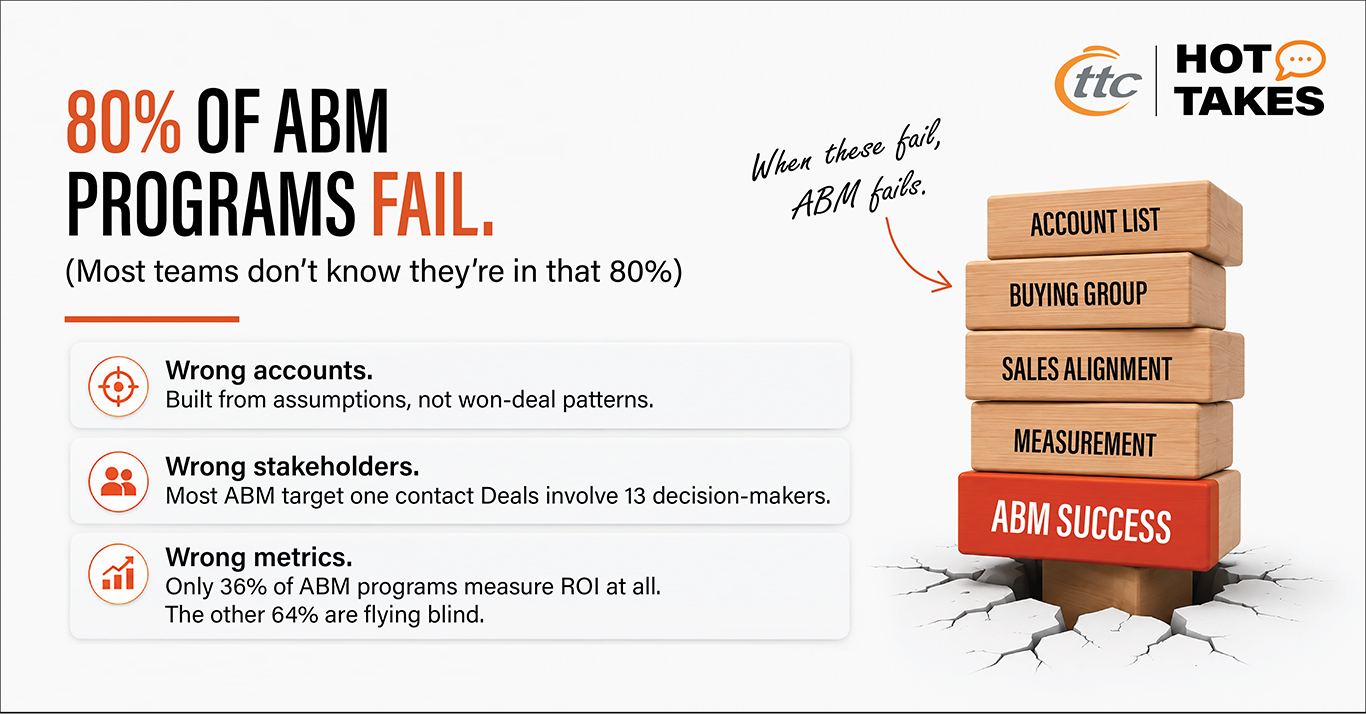
Here’s the one that doesn’t make the deck: 80% of ABM programs fail to meet expectations. And only 26% of teams running ABM describe it as truly successful.
80% of ABM programs fail to meet expectations — ABM Agency 2026.
55% say ABM influences only 0–20% of company revenue — N.Rich 2026/
64% of ABM programs sit entirely with marketing; sales owns just 13% — N.Rich 2026.
“Most companies are running targeted demand generation with better-looking slides and calling it ABM. Those are completely different things.”
ABM works when it’s a GTM operating model: permanent, always-on, coordinating marketing, sales, and RevOps around the same accounts and the same revenue outcomes. What most teams are running is a campaign with an account list. They pick 200 companies, personalise a few emails, run some LinkedIn ads, and wait. When nothing happens, they blame the tool. Not the approach.
ABM didn’t fail. The shortcuts did.
The root cause is almost always the same: the foundational work that should happen before any campaign launches was skipped. The ICP was never genuinely built from won-deal data. The account list was too broad because nobody wanted the fight about whom to leave out. The sales team wasn’t involved in account selection, so they don’t trust the list. The buying group was never mapped, so outreach landed on the wrong person at the right company. And when the CEO asks what ABM is delivering, the answer is engagement metrics. They wanted revenue metrics.
What fails first: The account list. Built from assumptions, not won-deal patterns. 42% of ABM teams say they can’t identify the right buyers inside their own target accounts.
What fails second: The buying group. Most ABM targets one contact per account. The average B2B deal involves 13 decision-makers. If you’re only talking to one, you’re running slightly better cold email.
What fails third: The measurement. Only 36% of ABM programs measure ROI at all. The other 64% are spending serious budget with no formal way to prove or disprove whether it’s working.
The teams that make ABM work made one quiet decision: they accepted that doing it properly is slower and harder than running a campaign. They built the ICP from actual closed-won data. They mapped every stakeholder in the buying group before writing content. They created a shared pipeline metric that both marketing and sales owned. Teams with that alignment are 80% more likely to hit pipeline goals than those without it.
The audit that takes five minutes:
Pull up your ABM account list. Ask your sales team how many they’re actively working. If the answer is less than 30%, the problem isn’t the campaign; the list was never built with sales in it.
TTC’s POV
ABM isn’t a channel. It’s a commitment. Most teams made the investment without making a commitment.
When a client tells us their ABM isn’t converting, the first thing we look at isn’t the campaign. It’s what they’re calling ABM. Nine times out of ten, it’s a well-funded, well-tooled campaign with no shared account ownership, no buying group intelligence, and no connection between the marketing dashboard and the sales team’s actual reality.
We help B2B brands build ABM as a system, starting where most programmes never start: with an ICP built from won data, an account list that sales actually believes in, and buying group mapping that tells every team member who they’re trying to reach and why. The campaign comes last. Everything that determines whether it works comes first.