

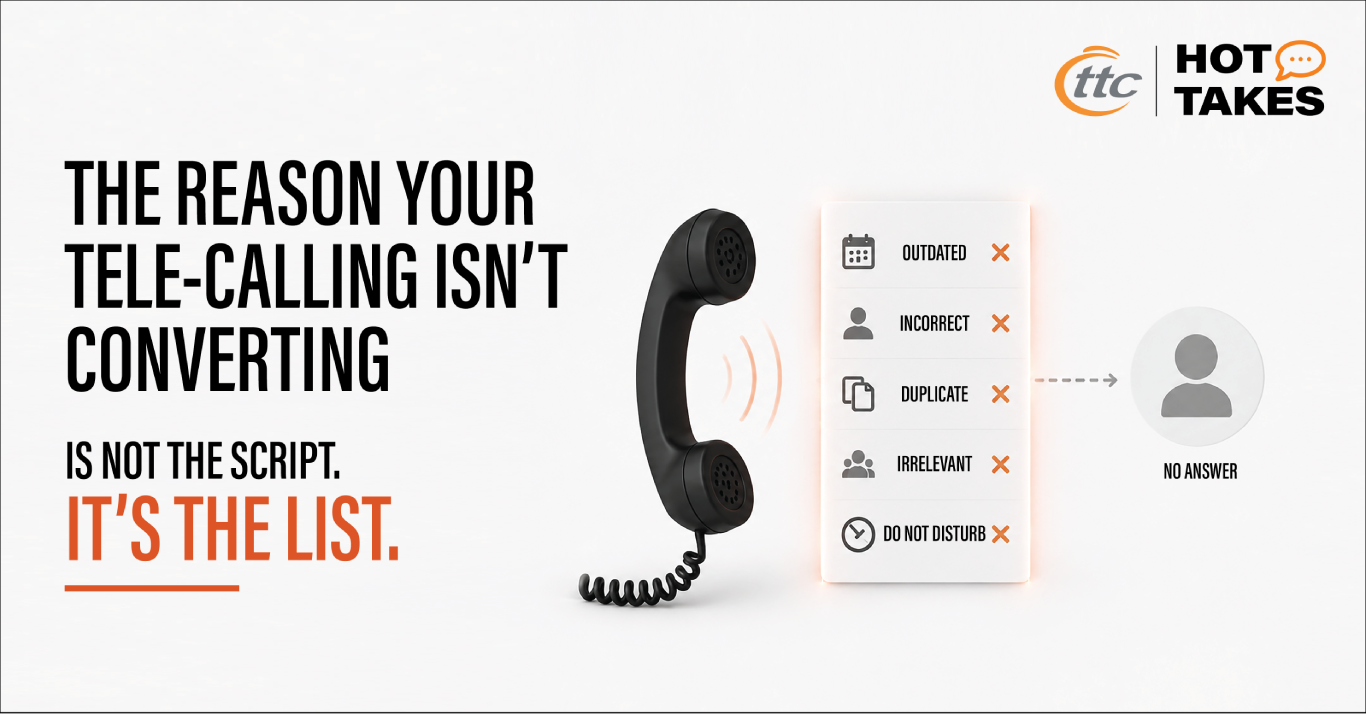
23 Sep Hot Take: The Reason Your Tele-Calling Isn’t Converting Is Not the Script. It’s the List.
The rep did everything right—sharp opener. Confident tone. A pitch that actually sounded like it came from someone who understood the problem. And the call still went nowhere because the person on the other end hasn’t worked there in four months.
This happens hundreds of times a day across B2B tele-calling teams. And almost every time, the post-mortem lands on the same suspect: the script.
New script. New training. New objection-handling framework. New role-play session on Tuesday morning.
Same results.
Because the script was never the problem.
Here’s what nobody in the room wants to say: the list was broken before the first dial went out. Wrong number. Outdated title. Decision-maker who left six months ago. A contact record that looks fine in the CRM and is completely useless in real life.
You can’t script your way out of calling a ghost.
70.3% of B2B contact data decays every single year.
95% of GTM leaders reported negative performance from poor data quality in 2025.
Hours & hours per year are wasted by the average sales rep chasing leads built on bad data.
Read those together, and the picture gets uncomfortable fast. If 70% of your list is degrading annually, and you refresh it once a year at best, you’re asking your team to perform at a high level with tools that are already failing them. The opener isn’t weak. The list is stale. And blaming one for the failures of the other isn’t just wrong. It’s expensive.
The market has made tele-calling harder, yes.
Cognism’s 2025 State of Cold Calling report put the average success rate at 2.3%.
Some will read that and declare the channel dead. That’s the wrong conclusion. The right conclusion is that not every list deserves the same effort, and pretending otherwise is where most teams quietly waste the majority of their time and confidence.
The best tele-calling teams know something most managers miss: this isn’t a script contest. It’s a precision game. Apollo’s research shows that top-performing cold callers need just 8 calls to land a meeting. Average reps need 19. Same channel, same pressure, wildly different outcomes.
And the difference is almost never the language. It’s who they’re calling; how current the contact is, whether the person has a reason to care, and whether the number actually rings through to someone who can say yes.
There’s also something darker here that doesn’t show up in the data: what bad lists do to the people dialing them. A rep who makes 60 calls a day into a broken list doesn’t just underperform. They start to believe they’re the problem. They lose confidence in the pitch before they’ve had a fair chance to test it. They quit, or they stay and go through the motions, which is worse. Bad data is a morale problem as much as it is a revenue problem. The industry just doesn’t talk about it that way.
A great script opens the door. A strong list gets you to the right door. Only the right door leads anywhere worth going.
The question to ask before the next training session: When did you last audit the list your team is calling from? Not the tool it lives in. The actual data inside it. If the answer is “we haven’t” or “a while ago”, that’s your real conversion problem. Right there.
TTC’s POV:
Tele-calling is not a volume game. It’s a relevance game. And relevance starts before the first dial.
At TTC, when a client tells us their tele-calling isn’t converting, the first thing we look at isn’t the script. It’s the list.
We work on the things that actually determine whether a call has a chance: list quality, data freshness, ICP alignment, and outreach sequencing that reflects where the contact actually is, not where they were when someone last updated the CRM. Clean data. Current decision-makers. Smarter targeting.